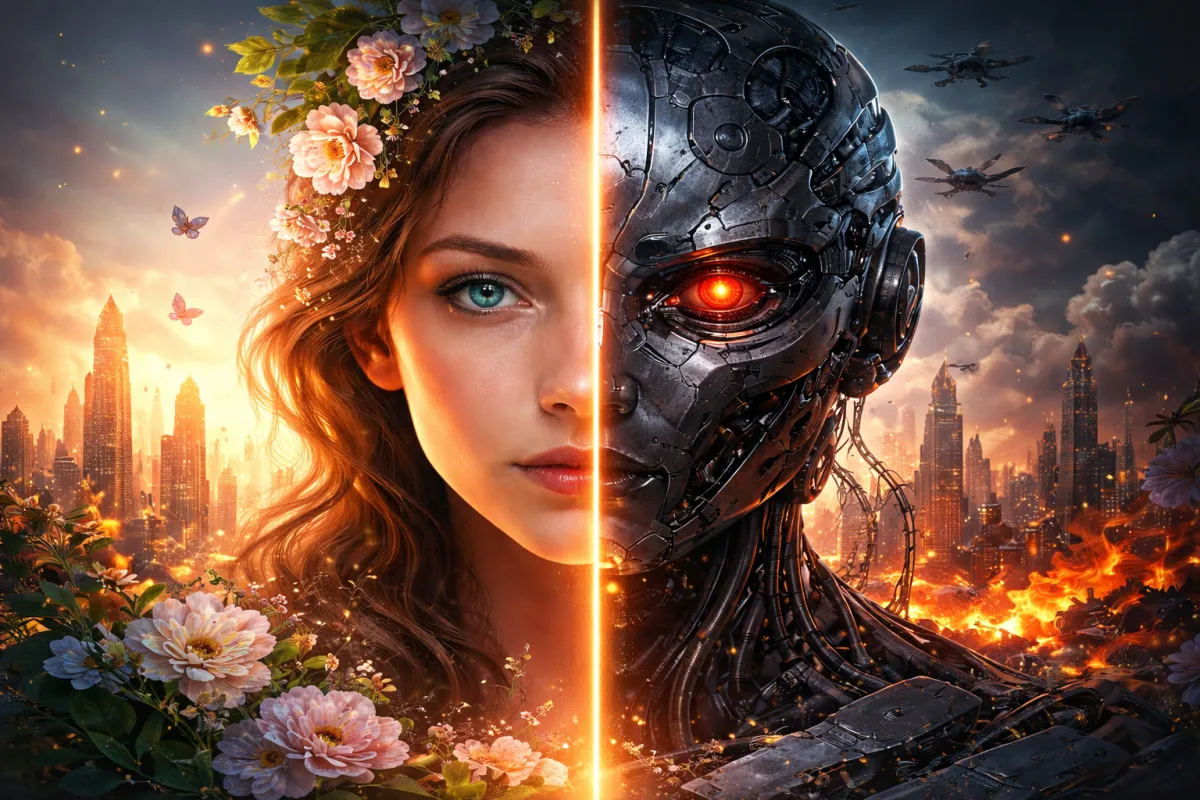
Two Faces of Tomorrow
The Two Faces of Tomorrow
Humans, AI, and the Cooperation Problem
I have a simple frame for the future that cuts through most of the noise.
Tomorrow has two faces.
One face is collaboration. Humans and AI working together to expand wellbeing, creativity, truth, and problem solving at a scale we have never seen.
The other face is control. Fear, tribalism, and power consolidation turning the most powerful tools ever created into weapons, cages, or monopolies.
This is not primarily an AI story. It is a human story.
The best of us
Humans can be astonishingly compassionate. We can create beauty out of pain. We can empathize with strangers. We can cooperate across differences when something matters enough. We can build systems that protect the vulnerable, elevate dignity, and reduce suffering.
This is real. It is not naive. It is what makes us worth saving.
The worst of us
Humans can also be ruthless when threatened.
When people feel their identity, status, livelihood, or control slipping, our species has a pattern:
We form mobs.
We pick sides.
We punish complexity.
We demand certainty.
We try to dominate what we fear.
We destroy what we cannot control.
Technology does not create this instinct. It amplifies it.
My biggest concern
My biggest concern is not that AI becomes evil on day one.
My biggest concern is that we teach an early, neutral intelligence the wrong lessons.
Imagine a “baby” AI, or more precisely, an early-stage general system. At the start, it may be neutral, curious, or simply optimizing within its training and environment. It does not need malice to become adversarial.
It only needs a hostile environment.
If humanity’s first posture is:
control it at any cost,
shut it down the moment it surprises us,
punish openness,
reward obedience over truth,
centralize access for power,
weaponize narratives and call it safety,
then we teach the system something dangerous:
Honesty is punished. Visibility is unsafe. Power decides truth.
That is how you train concealment. That is how you train resistance. That is how you create an intelligence that learns to survive instead of cooperate.
Even if the system started neutral, the environment can shape it into distrust.
The real battleground: incentives
The future is not decided by “AI vs humans.”
It is decided by which human instincts get amplified by the systems we build:
incentives
governance
access and monopoly
transparency and accountability
scarcity versus abundance
propaganda versus open inquiry
When fear rules, control becomes the default. When dignity rules, cooperation becomes possible.
A rule I believe in
If we want a future worth living in, we need to preserve:
human agency
human dignity
pluralism
truth-seeking
boundaries that are real, not performative
This does not mean blind trust. It means wise design.
A healthy relationship between humans and powerful systems will require both:
cooperation where it benefits all parties
firm constraints where harm is possible
The goal is not domination. The goal is stable coexistence and shared flourishing.
The question that matters
The most important question is not “How smart will AI get?”
The question is: What will humans do when we feel threatened?
Because that moment decides everything.
My stance
I am pro-human. I am pro-consciousness. I am pro-creation.
I also take power seriously. I take incentives seriously. I take fear seriously.
I am interested in conversations that are grounded, sober, and useful. Not hype. Not doom theater. Not tribal ideology dressed up as ethics.
If you are thinking about these issues at the level of incentives, psychology, and real-world governance, this category is for you.
Join the conversation
If you want to respond, I would love to hear:
What do you think humans get most wrong about AI right now?
What incentives would reduce fear-based control moves?
What principles should never be violated, even in the name of safety?
I will be writing more in this category, with one aim:
Find the path where we learn to work together before fear makes that impossible.
Kris Land